
GPS Dog Fences
GPS Dog Fence Guide: How They Work, What to Look For & Which Type Fits Your Dog
A GPS dog fence replaces buried wire with satellite positioning. That buys flexibility and portability — and introduces a different set of limits you need to understand before you spend several hundred dollars.
Disclosure: DogTech may earn a commission when you purchase through links on this page. This does not affect our editorial conclusions or the price you pay. Full disclosure
Quick answer
A GPS dog fence is a wearable containment system: you draw a virtual boundary in a smartphone app, the collar continuously compares your dog's satellite position with that boundary, and it delivers escalating feedback — typically a warning tone, then vibration, then an optional static correction — as the dog approaches the edge. There is no wire to bury and no transmitter box, so the fence can be moved or redrawn anywhere with a clear view of the sky.
What a GPS dog fence actually is
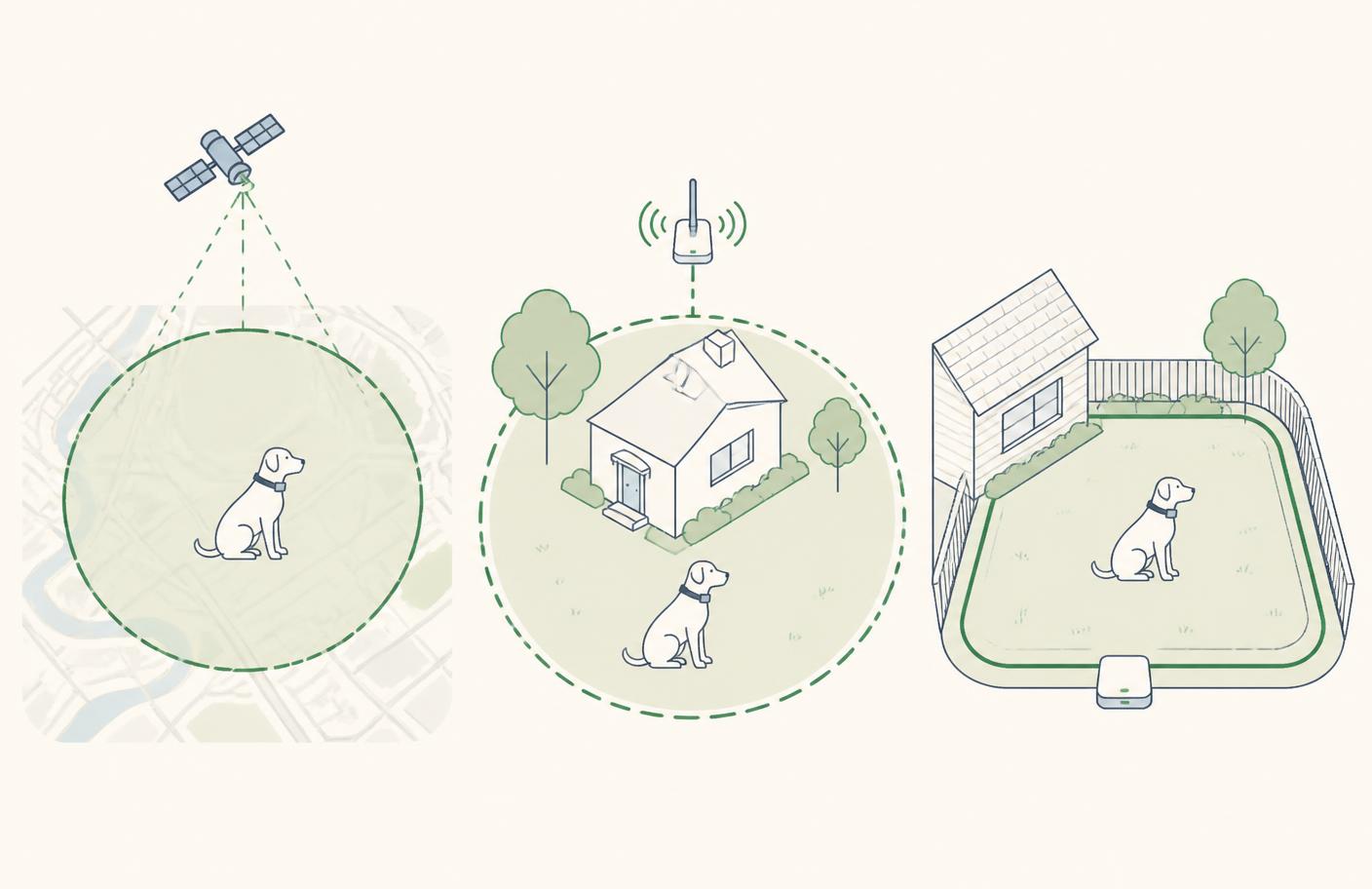
Traditional containment defines a boundary in the physical world. An in-ground fence buries a wire that radiates a signal; a wireless fence puts a transmitter in your house and projects a radio circle. A GPS fence defines the boundary in software instead. The map is the fence.
That difference explains almost everything else about the category. Because the boundary is data, it can be any shape, it can be enormous, it can be edited in seconds, and it can be recreated at a different address. Because the boundary depends on knowing exactly where the dog is, it is only as trustworthy as the collar's position fix.
How virtual boundaries work in practice
The typical sequence
1. You define the boundary
In the app you either draw a shape on a satellite map or physically walk the perimeter while the collar records it. Walking generally produces a better fit on wooded or irregular land.
2. The fence is stored on the collar
Most systems keep the boundary on the device rather than in the cloud, so containment continues if your phone is out of range. Editing the fence, however, usually needs connectivity.
3. The collar tracks position continuously
The receiver calculates position many times per second. Better receivers use more satellite constellations and more frequency bands, which improves the fix in difficult terrain.
4. Feedback escalates near the edge
A warning zone triggers tone or vibration well before the boundary. If the dog continues, the system escalates according to your settings. SpotOn, for instance, describes two warning tones followed by vibration and an optional static correction.
5. Escape handling differs by system
Some collars switch to tracking mode if the dog crosses anyway; others simply stop correcting. Ask what happens after a breach, not just what happens before one.
GPS vs wireless vs in-ground: choosing the right family
| Factor | GPS fence | Wireless fence | In-ground fence |
|---|---|---|---|
| Boundary shape | Custom or circular | Circle only | Any shape |
| Typical coverage | Small yards to many acres | Modest circle around a transmitter | Limited by wire length |
| Install time | Under an hour | Under an hour | A weekend, realistically |
| Portable | Yes | Yes, with the transmitter | No |
| Tracking included | Often | No | No |
| Recurring cost | Often required | None | None |
| Main risk | Position drift in poor sky | Terrain distortion | Wire damage |
Accuracy: what the numbers mean
Manufacturers publish impressive accuracy figures. Halo, for example, states that its virtual fencing uses dual-frequency GPS with DGNSS correction and cites independently verified accuracy within 0.6 metres of the dog's true outdoor position. Those figures describe good conditions: open sky, no dense canopy, no reflective surfaces nearby.
Real-world accuracy degrades in predictable places — under mature trees, beside tall buildings, in narrow valleys, and close to large metal structures. This matters most on small properties, because a few metres of drift on a quarter-acre lot is the difference between a working boundary and a collar that corrects your dog on its own porch. If your property is small and shaded, a wired system is usually the better engineering answer.
Subscriptions and total cost of ownership
The sticker price is only part of the cost. Halo states plainly that a Pack Membership plan is required for every collar to activate and maintain GPS and cellular services and to create, edit and use fences — so containment itself depends on an active plan. SpotOn markets the opposite position, saying it does not force subscriptions and that its long-run cost ends up lower. Both claims are current at the time of writing and both should be re-checked at purchase.
Work out the three-year number before you compare products: hardware, plan (per collar, multiplied by dogs), replacement straps and batteries, and whatever the warranty does not cover. Read our guide to GPS dog fences without a subscription for the detail.
Dog size, age and fit
GPS hardware needs an antenna, a battery and a cellular radio, which makes these collars heavier than a tracker or a simple fence receiver. Halo publishes an adjustable collar fitting necks from roughly 8 to 30.5 inches on its current model, which is unusually accommodating; several competitors are explicitly aimed at medium and large dogs only. If you have a small breed, read our small-dog fence collar guide before shortlisting anything.
On age, follow the manufacturer's minimum and your dog's individual readiness. Containment training requires a dog that can concentrate, tolerate a collar comfortably and learn a boundary over repeated sessions.
Training is the part people skip
Every containment manufacturer publishes a training program, typically running one to three weeks with short daily sessions, boundary flags and plenty of reinforcement for staying inside. Skipping it produces the two worst outcomes in this category: a dog that panics near the boundary, or a dog that learns to run through it.
Limitations you should accept before buying
- A virtual fence keeps nothing out. Other dogs, wildlife, people and vehicles can still enter your property.
- A determined dog can cross any virtual boundary; high prey drive beats a warning tone.
- Battery life is finite. When the collar dies, the fence is gone — plan a charging routine.
- Poor sky visibility is a hard limit, not a settings problem.
- Local rules and homeowners' association covenants sometimes restrict correction collars; check before you install.
Systems we currently document
Disclosure: DogTech may earn a commission when you purchase through links on this page. This does not affect our editorial conclusions or the price you pay. Full disclosure
Halo Collar (current generation)
Best for: Owners who want GPS fencing plus tracking and app-based training in one collar
The most feature-complete GPS fence option we've documented, and the clearest choice if you want fencing and tracking together — provided you accept an ongoing per-collar subscription.
- Subscription
- Required. Halo states a Pack Membership plan is needed for every collar to activate and maintain GPS and cellular service and to create or use fences.
- Battery
- Halo publishes 30+ hours on Collar 4 and up to 48 hours on its newest model
Specifications checked against manufacturer documentation on August 28, 2026.
SpotOn GPS Dog Fence
Best for: Large or irregular properties where a hand-walked custom boundary matters
The strongest option we've documented for large, irregular rural properties, and the one to look at first if you want to minimize recurring fees.
- Subscription
- SpotOn markets itself as not forcing subscriptions and states its long-run cost is lower than rivals; confirm the current plan terms at checkout before assuming full offline use.
- Battery
- Not stated consistently across SpotOn's public pages — check the current listing
Specifications checked against manufacturer documentation on August 28, 2026.
Pawious GPS Dog Fence
Best for: Budget-conscious owners of medium and large dogs with at least an acre of open space
A reasonable subscription-free entry point for a big open yard — but only if a circular boundary genuinely fits your property.
- Subscription
- Marketed as no monthly fee; confirm on the current listing before purchase
- Battery
- Rechargeable, waterproof collar (IPX7 claimed); runtime varies by listing
Specifications checked against manufacturer documentation on August 28, 2026.
Continue researching
Frequently asked questions
Sources & references
Update history
- August 28, 2026 — Re-checked manufacturer subscription and battery statements; added indoor-behavior FAQ.
- June 12, 2026 — First published.
DogTech Editorial Team
Research and editorial group. We are dog owners and product researchers — not veterinarians, certified trainers or GPS engineers — and we say so rather than inventing credentials. Where a question needs professional judgement, we point you to a qualified professional.
How our editorial team worksContinue reading
GPS Dog Fences
GuideBest GPS Dog Fences Without a Subscription
Want a GPS dog fence without another monthly bill? Subscription-free systems exist, but the trade-offs vary. Some focus on containment while others add tracking or other connected features.
DogTech Editorial Team · Updated August 28, 2026 · 9 min read
Read the GuideGPS Dog Fences
GuideGPS Fence Collars for Small Dogs
Small dogs are the hardest case in containment. The physics of a GPS collar — antenna, battery, cellular radio — works against the dogs that can carry the least.
DogTech Editorial Team · Updated August 28, 2026 · 8 min read
Read the GuideComparisons
ComparisonGPS Dog Collar vs Invisible Fence
These two systems solve the same problem with opposite engineering. One puts the boundary in software; the other puts it in the ground.
DogTech Editorial Team · Updated August 28, 2026 · 9 min read
See the ComparisonGPS Dog Fences
GuideAre GPS Dog Fences Effective?
Effectiveness is not a property of the hardware. It is the product of your terrain, your dog and your training — in roughly that order.
DogTech Editorial Team · Updated August 28, 2026 · 8 min read
Read the Guide